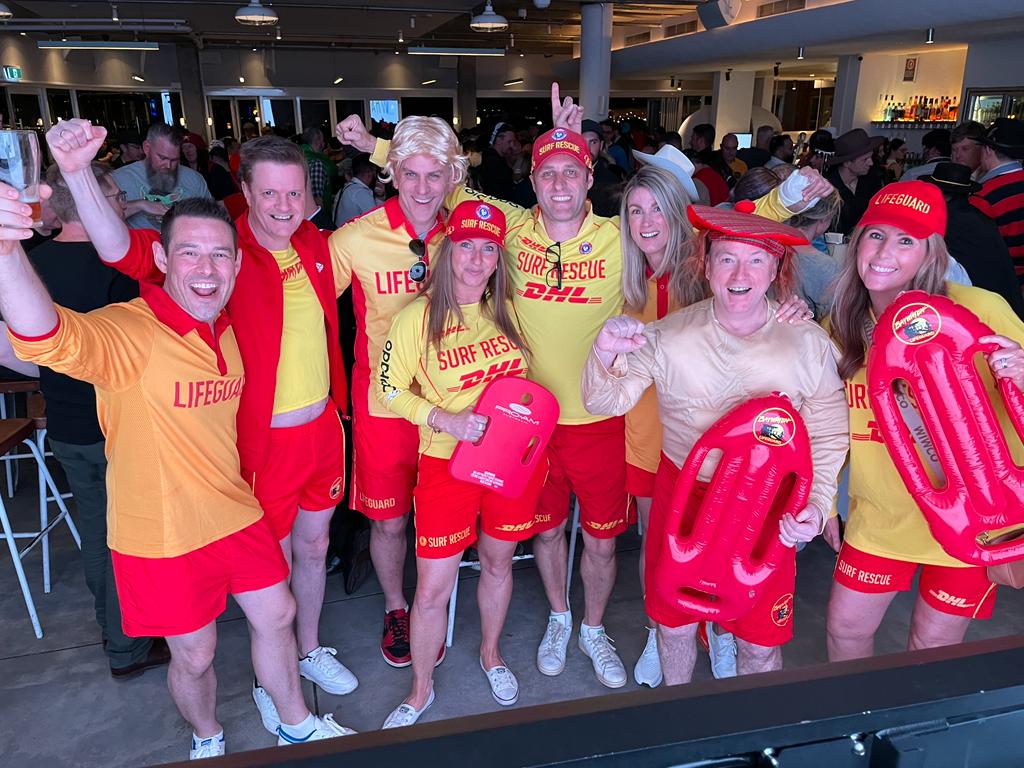
Don't forget to have some fun while you're chasing growth
Sales can be a hard task - asking more of your team without creating the right environment doesn't get the team behind you - recognition and fun must be part of your strategy!
Read moreInterview
Andrew Wildblood sits down with Strategist and Advertising expert Al Crawford to discuss his perspective on aligning for growth.
Andrew Wildblood, Co-Founder and Chief Executive Officer · 3 November 2026
For our first episode of Aligning for Growth, I sat down with an old colleague, strategist and advertising expert Al Crawford.
Al calls himself an accidental tourist in marketing. Advertising came straight after accountancy and actuarial services in the careers booklet, and he admits he can't add up particularly well. Twenty years in advertising followed, including two decades working with the Guardian, and for the last ten he's run his own business. In his more pompous moments he'd call himself a consultant to marketers. In his words, he's really "a pet nerd to chief marketing officers".
I think the world is a better place for him skipping accountancy. Here's what stayed with me from our conversation.
I asked Al where he's seen organisations really line up. His answer was blunt: "corporate dislocation is more prevalent than corporate unity."
He pointed to a recent YouGov staff survey in which only around one in five employees felt leadership was clearly articulating its vision and direction. Plenty of people doing plenty of things. Whether those things add up to a strategy is another question.
That rings true for me. When a business tells us it isn't selling enough, or growth is nowhere near its potential, it's never just one thing. It's alignment.
The good news is that the organisations who get it right really stand out. Al gave two examples.
The first was Adobe and its promise of creativity for all. It isn't a tagline on a website. You can see it in the products, in pricing that lets anyone start for free before paying for the full toolkit, in its community programs, and in the internal labs where it incubates its own ideas rather than simply buying them in.
The second was the Guardian, whose ambition is to be the world's leading liberal voice. That one idea explains almost every commercial decision it makes. There's no paywall, because a voice built on reach can't lock its readers out. It's backed by the Scott Trust, which exists to protect its independence rather than chase profit. And it has expanded well beyond London, because a global voice can't stay at home.
When the purpose is that clear, pricing, product, distribution and culture stop being separate debates. They become expressions of the same decision.
My favourite story from the episode was about a wealth platform Al has been working with.
From the outside, there was nothing to fix. Net inflows were enormous, quarter after quarter. Yet it was the sales team who asked for help. Their message was that they weren't clear on who they were or where they were going, and it was hurting how they sold to clients and how they inspired their own people. They wanted a story they'd be proud to tell in a client conversation.
That's something we see again and again at Caidence. I've written before that your sales problem might not be a sales problem. Sales is usually just where an alignment problem shows up first.
The work that followed was less about messaging and more about getting the executive team radically aligned on how they described themselves, to the market and to their own staff.
Al has since written an article about realising he's a storyteller after all. I won't repeat the first two words of the title here, but it made me laugh. As he says, storytelling can sound like a bedtime activity. But a hard-edged narrative, where everyone knows the destination, what the organisation stands for and the proof underneath, is incredibly valuable. People come to work knowing where they're going and how they'll get there.
Al's diagnosis of where growth goes missing is simple. Organisations drift from being market oriented to product oriented, and as soon as you lose sight of the customer, you lose sight of your source of growth.
So almost every piece of work he does starts in the same place: let's talk to your customers. For the wealth platform, that meant candid conversations with financial advisers.
It took me back to when Al and I worked together in a previous organisation, and I got him out talking to our customers. Even when you trust your sales team, a third party hears things a client would never say to your own people. As Al put it, the value isn't so much expertise as candour.
Most organisations think they know their customers better than they do. In Bain & Company's well-known study of 362 firms, 80% believed they delivered a superior experience. Their customers said only 8% did.
I've always told my sales teams the same thing. If you're not talking to your customers, someone else is.
Al added a modern twist. There's a deluge of data these days, and it can create an empathy gap, reducing people "to ones and noughts rather than beating hearts". Being visible to machines matters. Understanding the human at the end of the funnel matters more.
Accelerate, don't abdicate
You can't have a conversation about business in 2026 without AI, and Al's view was refreshingly balanced. "Technology is awesome, but it is as awesome as you make it."
He thinks we're in the middle of a washing machine cycle: excited, overwhelmed and still working out which way is up.
His warning is about what he calls cognitive surrender. Use technology to accelerate and augment your skills, not to abdicate them. His advice to people starting out is to feel some of the pain rather than asking a tool to take it away, because the apprenticeship is in the job.
The early research backs him up. A Microsoft Research and Carnegie Mellon study of 319 knowledge workers found that the more people trusted AI, the less critical thinking they applied. Those confident in their own expertise questioned it more.
AI amplifies whatever is already there. Applied to a clear strategy and real customer understanding, it lets you move faster. Applied to a fuzzy commercial model, it just scales the noise. Al calls himself "a good cyborg": human judgement plus the technology. I think that's a pretty good model for any leadership team.
Where the very best organisations stand apart is clarity. They're aligned on purpose, clear on what their customers need, and only then using technology to move faster.
A few questions worth asking your own team:
My thanks to Al for a brilliant conversation. You can watch the full episode on our YouTube channel: https://youtu.be/WAsAMUAcv64
At Caidence, we look at the whole commercial engine, because growth rarely stalls for just one reason. If your answers to those questions are less certain than you'd like, that's often where growth is hiding, and we'd love to have a conversation.
Sales can be a hard task - asking more of your team without creating the right environment doesn't get the team behind you - recognition and fun must be part of your strategy!
Read moreThe real AI opportunity is not better tooling - it is building the commercial system strong enough for AI to amplify.
Read moreReplacing the sales leader rarely moves the number. The cause is usually somewhere else.
Read moreBook a discovery call and we'll walk you through our Revenue Engine Diagnostic™.