Aligning For Growth - Al Crawford
Andrew Wildblood sits down with Strategist and Advertising expert Al Crawford to discuss his perspective on aligning for growth.
Read moreInsight
Sales can be a hard task - asking more of your team without creating the right environment doesn't get the team behind you - recognition and fun must be part of your strategy!
Andrew Wildblood, Co-Founder and Chief Executive Officer · 19 October 2026
When did we all get so serious about growth?
Targets, pipeline, forecasts, performance reviews. All important, of course. But somewhere along the way, we sometimes forget that it's people who deliver the results.
Across my career, I've found that the best-performing teams aren't just the ones with the strongest strategy. They're the ones that genuinely want to win together. They bring discretionary effort, have each other's backs and enjoy what they do.
I've always believed you can have high expectations, hold people accountable and still have a lot of fun along the way.
Culture is part of the engine
Culture is what your team does when nobody is checking in. It's what people say and do when you're not there. Importantly, it's how your people show up internally and externally, with customers and partners.
That makes culture a commercial leadership asset, not simply an HR initiative.
The numbers back this up. Gallup's long-running research into employee engagement found that the most engaged business units delivered 18% higher sales productivity and 23% higher profitability than the least engaged.
But you don't need research to recognise the difference between a team that's going through the motions and one that's genuinely pulling together.
Pressure cooker or enabled culture?
Most of us have worked in the other kind of place, where it feels like a pressure cooker.
There's little care for the people or the reality of the market. Targets arrive from above with no context. Politics gets in the way, divisions form across the company and even within teams.
Pipeline reviews feel like interrogations, so people sandbag, hide bad news and protect their patch. Engagement becomes transactional. People do what the comp plan pays for and nothing more.
And the best ones quietly leave.
The late Sumantra Ghoshal, a professor at London Business School, captured this brilliantly in his famous talk, The Smell of the Place.
He compared spending a summer day in downtown Calcutta, where he grew up, with walking through the forest of Fontainebleau in spring.
One leaves you feeling drained and lethargic. The other makes you feel energised and ready to take on the world.
The people haven't changed. The environment has.
His argument was that too many companies create the equivalent of Calcutta in summer inside their own walls.
Ghoshal identified four shifts leaders need to make:
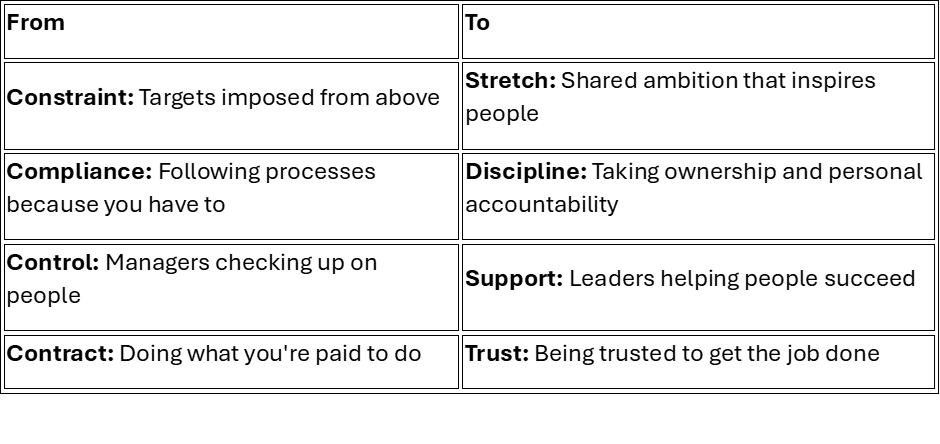
His message was simple. Changing behaviour isn't about changing people. It's about changing the environment they work in.
Both cultures might hit a quarter. But only one is likely to sustain growth because only one earns the effort people choose to give.
Accountability without fear
Great go-to-market teams hold each other to account without blame.
In a healthy pipeline review, people bring the deals they're worried about because that's where help is most useful. They review lost deals as seriously as wins, asking what the market is telling them, not who dropped the ball.
And leaders go first.
When a sales director says, "I called that one wrong," everyone else gets permission to be honest.
That's how you build accountability without creating fear.
Recognise and reward
Discretionary effort follows recognition.
Gallup and Workhuman tracked nearly 3,500 employees from 2022 to 2024 and found that well-recognised people were 45% less likely to have left their organisation two years later.
Yet only 22% of employees say they receive the right amount of recognition.
At Vocus, we introduced a High Achievers Club to reward top performance. Crucially, we broadened it beyond sales to include operations, showing the whole business that winning was a shared effort.
The trip became coveted and a real motivator for people across both teams.
But it was never all about money.
Some of the most powerful recognition was the simplest. A shout-out in front of peers, a quick message to say "good job", or a personal note from the CEO.
Often, just being recognised was the reward.
Have some fun
Go-to-market work can be draining. Rejection, missed targets and long sales cycles can take their toll.
Having fun is one way a team refuels, and there's evidence that it pays.
Research from Oxford's Saïd Business School, involving sales staff at BT's contact centres, found that workers made around 13% more sales when they were happier, without working longer hours.
At Telstra International, our sales kick-offs brought together teams from more than 20 countries to celebrate, learn and align.
In 2014, we asked each country to create a video about their country, their business and their culture, filmed only on a phone.
It was a massive success. No money involved, other than the winning video, voted for by everyone, being played at kick-off.
And then there was the Korean team performing Gangnam Style on stage, bringing the house down!
We also held a national dress day to celebrate our diversity. The head of Japan and his team arrived in sumo wrestling suits, Team USA came as Captain America, and the Brits turned up in bowler hats.
At Vocus, I stood on stage at our kick-offs in front of 300 people, with teams from across the company alongside our key go-to-market channel partners.
You could almost taste the culture in the room.
I always said that if I could bottle culture, it would be at moments like those.
They galvanised the team for the start of the year, set out the strategy with real clarity and built engagement right across the business and out to our partners.
And that's the point. These weren't just fun events. They helped people understand where we were going, built relationships across the business and created a genuine sense that we were all in it together.
When it came time to execute, that mattered.
When you can't be in the room
Covid tested all of this.
With everyone working from home, I sent book vouchers to every member of my teams. A small gesture to help people feel connected and valued.
We then got together to talk about the books people had read. It was a simple way to create connection and involvement at a time when isolation could easily have taken over.
Like many businesses, we also ran Friday connection sessions on Teams, from cocktail making to interviews with sports and business leaders.
We had some incredible guests, including Steve Wozniak, Olympic champion Ariarne Titmus and her coach Dean Boxall, adventurer Turia Pitt and others.
We invited our customers too, which showed our customer culture in action rather than just talking about it.
Moments like these build the trust that accountability depends on.
Gallup's research links close friendships at work to higher profitability and retention, and highlights the role leaders play in encouraging those connections.
It's far easier to pick up the phone to a colleague on another continent, ask for help or hear some tough feedback when you've shared a laugh with them.
And in a commercial environment, where success depends on people working together across sales, marketing, operations and customer teams, those relationships really matter.
Leaders set the culture our people thrive in
Culture isn't the values statement on the wall.
It's what leaders reward, tolerate and model every week. And that includes how seriously they take themselves.
Benjamin Zander, conductor of the Boston Philharmonic and co-author of The Art of Possibility, once spoke at a Telstra sales event.
He shared his Rule Number 6, told through a story of two prime ministers who calm a string of furious visitors with a single reminder: don't take yourself so seriously.
(Zander's version is a little more colourful!)
It has stayed with me ever since.
Being a senior leader is no reason to stand apart.
Put yourself out there. Dress up at events. Be yourself, and let people see you laugh, including at yourself.
When leaders are relatable, people are more likely to bring them the real story. They build trust, they build connection, and they create an environment where people want to go the extra mile.
And when you're trying to execute a growth strategy, you need that effort from right across the business. Not just the sales team.
So take an honest look at your own diary and your own reactions.
Are you building a team that wants to win together, and enjoys doing it?
Because executing a growth strategy is hard work. There's no reason you can't have some fun along the way.
At Caidence, we believe sustainable growth comes from looking at the whole commercial engine, not just sales targets and pipeline. The people, the culture and how teams work together are every bit as important as the strategy itself.
If you're planning your next phase of growth and want to understand what's helping or holding your business back, we'd love to have a conversation.
Sources
Andrew Wildblood sits down with Strategist and Advertising expert Al Crawford to discuss his perspective on aligning for growth.
Read moreThe real AI opportunity is not better tooling - it is building the commercial system strong enough for AI to amplify.
Read moreReplacing the sales leader rarely moves the number. The cause is usually somewhere else.
Read moreBook a discovery call and we'll walk you through our Revenue Engine Diagnostic™.